

Aortic Valve Replacement
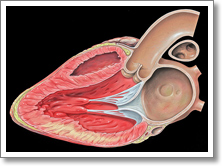
The aortic valve is located between the powerful left ventricle and the aorta (the body’s largest blood vessel), and ensures that blood is pumped forward from the heart to the rest of the body. The two main types of problems with the aortic valve are aortic stenosis (narrowing of the valve) and aortic regurgitation (leaking of the valve).
With advances in modern surgical techniques, surgeons now have multiple methods to repair or replace the aortic valve. The following section describes traditional "open heart" aortic valve replacement surgery. The surgeons of Raney Zusman Medical Group are also participating in a new type of aortic valve replacement for high risk surgical candidates. Please see our section on transcatheter aortic valve replacement for more information.
Aortic Valve Replacement Options
There are different types of replacement valves that may be used to fix an aortic valve. These include homograft aortic valves (from a human donor), mechanical aortic valve replacement, and stentless aortic valve replacement. Our surgeons also perform the Ross Procedure for aortic valve replacement, where the patient’s own pulmonic valve is moved to the aortic valve position, and a homograft valve is placed in the pulmonic valve position. Each valve type as certain advantages and disadvantages, and the decision to use a certain type of valve is made after a discussion and close evaluation of your records by a heart surgeon.
Preparing for Aortic Valve Replacement Surgery
All patients will meet with a heart surgeon before aortic valve replacement surgery. The surgeon will review the patient’s records and discuss the planned surgery, as well as answer any questions that the patient may have. Prior to your surgery, you will have a full evaluation to minimize unseen problems during surgery. You should bring a list of all medications to your appointment before surgery. Your surgeon will evaluate all your medications and give you specific instructions on which medications to stop prior to your surgery. Please see our section on preparing for heart surgery for more information.
The Aortic Valve Replacement Procedure
Once you have arrived in the operating room, the anesthesiologist will "put you to sleep" with medications, known as general anesthesia. General anesthesia involves IV and inhaled medications that are used to prevent pain and keep you asleep during surgery. You will not remember the events during surgery. A cardiac anesthesiologist has specialized training in heart surgery, and closely monitors consciousness and vital signs throughout the operation. The anesthesiologist is also responsible for placing an endotracheal tube from the patient’s throat to the lungs. This tube provides a secure airway between a ventilator machine that will do the work of breathing during surgery. The patient’s heart rate and rhythm are monitored throughout the operation with a continuous EKG machine.
Once the patient is asleep, the surgeon typically makes an incision down the middle of the chest and separate the breastbone, known as a sternotomy. Some operations may be performed with minimally invasive surgical techniques, which do not require a sternotomy. A heart-lung machine is used to do the work of breathing and pumping oxygenated blood for the patient. The patient’s major blood vessels are connected to the heart-lung machine during surgery, which allows the surgeon to operate on the heart without blood flowing through the heart. The heart is then slowed with cooling solution and medications. This allows the surgeon to perform surgery without any beating of the heart.
The surgeon will then access the heart and carefully remove the damaged valve. After the valve has been removed, the surgeon will replace the damaged valve with a replacement valve. The surgeon uses sutures to carefully sew the heart back up. The heart is then warmed up until it begins to beat on its own, and the patient is taken off the heart-lung machine.
After Aortic Valve Replacement Surgery: In the Hospital
After aortic valve surgery, the patient will be moved to the CVICU (Cardiovascular Intensive Care Unit) where specialized staff will closely monitor the patient. The patient remains on a monitoring system that closely evaluates the heart rate, rhythm, and vital signs. Medications will be given to control for pain, nausea, and constipation. The patient is encouraged to start activity after your surgery, and your caregivers will provide specific instructions regarding when to start activity and what type of activity should be done. Please see our section on recovery from heart surgery for more information.
Risks of Aortic Valve Replacement Surgery
Open-heart surgery is considered a major surgical operation and as such is associated with risks including stroke, heart attack, bleeding, infection, nerve damage, breathing problems, drug reactions, blood reactions, arrhythmias and death. Your surgeon will discuss these and other risks with you before your operation. Your surgeons and caregivers use many techniques to ensure that these risks are minimized. Fortunately these risks occur in a small percentage of patients undergoing heart surgery.
Our Statistics in Aortic Valve Surgery
Raney Zusman Medical Group recently received a 5-star rating for valve replacement surgery by Healthgrades, Inc. The group received 5/5 stars for in-hospital mortality (survival rate), in-hospital plus 1 month, and in-hospital plus 6 month survival rates. As the Healthgrades site shows, Raney Zusman Medical Group is the only Orange County cardiac surgery practice to receive 5 star ratings in all three areas.
Aortic Valve Replacement: Types of Valves
There are multiple types of replacement valves that may be used during aortic valve replacement surgery. These include homograft aortic valves (from a human donor), stentless aortic valves, and mechanical valves. Our surgeons also perform the Ross Procedure for aortic valve replacement, where the patient’s own pulmonic valve is moved to the aortic valve position, and a homograft valve is placed in the pulmonic valve position. Each valve type as certain advantages and disadvantages, and the decision to use a certain type of valve is made after a discussion with your surgeon and close evaluation of your records by a heart surgeon.Stentless Valves for Aortic Valve Replacement
Your physician may choose to use a stentless valve for aortic valve replacement. Stentless valves are porcine valves that are unique in that there is no additional structure (stent) added to the valve (as shown below).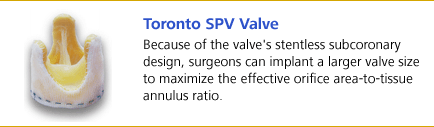
One main advantage of stentless valves is that blood thinners are not needed. Blood thinners are required with mechanical valves, and carry increased risk of bleeding, stroke, and other medical complications. In a stented valve, there is a ring that adds structure to the valve, but takes up space in the annulus. Stentless valves do not have this extra space, and have been shown to have superior hemodynamics (flow of blood) that more closely resembles the patients' own valve. Finally, stentless valves have the advantage of excellent long-term performance. There is a low percentage of replacement at 10 years post-surgery.
More information: NIH Article - Stentless Valve vs. Homograft for Aortic Replacement
Mechanical Valves for Aortic Valve Replacement
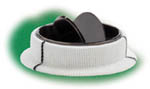 Mechanical heart valves used in aortic valve replacement are made up of durable components that do not react with the body's immune system. Mechanical valves are designed to last for a long period of time, and rarely require re-operation. The major drawback to mechanical heart valves is that blood clots can form on mechanical heart valves. This means that patients must remain on blood thinners (known as Coumadin or Warfarin) for the rest of their lives after receiving a mechanical heart valve replacement. Blood thinners are effective in preventing clots from forming on mechanical heart valves, but they have risks. Blood thinners increase the risk of bleeding, which can lead to bleeding in the brain (stroke) and other problems.
Homograft Valves for Aortic Valve Replacement
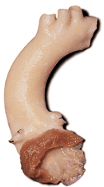 Homograft valves are taken from another human donor. They are removed, treated with antibiotics, and frozen for preservation. One main advantage of homograft valves is that blood thinners are not needed. Blood thinners (known as Coumadin or Wafarin) place patients at an increased risk of bleeding, which may lead to a stroke or other complication. In addition, patients with recurrent endocarditis (infection of the heart valve) may benefit from a homograft valve due to decreased risk of infectiton. Finally, there are certain aspects of each patient's anatomy that may indicate one valve choice over another. These considerations are highly detailed and must be carefully evaluated by a cardiac surgeon with extensive experience in valve replacement.
 Share Article