

Mitral Valve Surgery
Overview of Mitral Valve Surgery
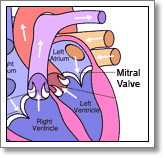 The mitral valve ensures that blood returning from the lungs flows forward from the left atrium and into the powerful left ventricle. The left ventricle then pumps blood to the rest of the body. There are three major problems that can occur with the mitral valve that require surgical repair. In mitral stenosis, the valve orifice (opening of the valve) becomes narrowed. In mitral regurgitation, the valve does not close properly, and blood flows backward when the valve should be tightly closed. In mitral valve prolapse, the valve does not close properly, and part of the valve bulges back into the left atrium. These changes may occur secondary to an infection, but are most commonly caused by gradual wear and tear on the valve.
If there is significant disease of the mitral valve, blood will not flow properly through the heart. This results in an elevated workload of the heart, and the heart muscle will begin to enlarge (known as "hypertrophy"). These changes eventually lead to symptoms in the patient. The most common is shortness of breath, which may be especially bad with exercise. Problems with the mitral valve may lead to irreversible changes that prevent the heart from pumping properly. Experts now recommend early surgery for mitral valve disease to prevent these irreversible changes.
Mitral Valve Repair versus Mitral Valve Replacement
Mitral valve replacement has been performed for decades to fix problems with the mitral valve. In mitral valve replacement, the diseased valve is removed during surgery and replaced with an artificial valve. This method is highly effective in fixing problems with the mitral valve, and remains the best treatment option in certain situations. Mitral valve repair has several advantages over replacement, and is the recommended treatment for the majority of patients requiring surgery.
 In mitral valve repair, the patient’s own mitral valve is repaired and function is restored to the valve. There are many advantages to mitral valve repair in the hands of a skilled and experienced surgeon. By using the patient’s own valve, there is better flow of blood through the valve because the basic structure remains in place. Mitral valve repair has been shown to be superior to valve replacement in terms of surgical mortality, long term durability of repair (which means a longer time before another operation might be needed), heart function, and long-term survival. Another important consideration is that patient’s receiving a mitral valve repair do not require blood thinners for the rest of their lives. Blood thinners (known as Coumadin or Warfarin) increase the risk of bleeding, require frequent monitoring, and may lead to stroke or other medical problems. In addition, blood thinners can not be used in women who may become pregnant as they cause severe damage to an unborn child.
Our surgeons peform mitral valve repair in 90 to 95% of patients with degenerative mitral valve disease (the most common type of mitral valve disease). The heart surgeons at Raney Zusman Medical Group repair more heart valves than any other medical center in Orange County, and this high volume of repair gives our surgeons expertise in mitral repair.
Preparing for Mitral Valve Surgery
All patients will meet with a heart surgeon before mitral valve surgery. The surgeon will review the patient’s records, discuss the planned surgery, and answer any questions that the patient may have. Prior to your mitral valve surgery, you will have a full evaluation to ensure that there will be no unseen problems during surgery. This includes a series of lab tests and other procedures that will minimize unforseen problems during surgery. You should bring a list of all medications to your appointment before surgery. Your surgeon will evaluate all your medications and give you specific instructions on which medications to stop prior to your surgery. Please see our section on preparing for heart surgery for more information about preparing for mitral valve surgery.
How is Mitral Valve Surgery Performed?
On the day of surgery, you will be taken to a “pre-operative” room where you change into a hospital gown. An anesthesiologist (physician responsible for “putting you to sleep” and monitoring during surgery) will start an IV line prior to surgery which is used to give fluids and medications during the surgery. “General anesthesia” is used in mitral valve surgery to put you to sleep, where IV and inhaled medications are used to prevent pain and keep you asleep during surgery. This ensures that you will not remember the events or experience pain during surgery.
Once the patient is asleep, the surgeon will typically make an incision down the middle of the chest and separate the breastbone, known as a sternotomy. (Some patients may be candidates for minimally invasive heart surgery). The patient will be placed on “cardiopulmonary bypass,” where a heart-lung machine is used to do the work of breathing and pumping oxygenated blood for the patient. The patient’s major blood vessels are connected to the heart-lung machine during mitral surgery, which allows the surgeon to operate on the heart without blood flowing through the heart. The heart is then slowed with cooling solution and medications. This allows the surgeon to perform surgery without any beating of the heart.
For mitral valve replacement, the surgeon will remove the diseased valve and replace it with a new valve. In mitral valve repair, the surgeon uses techniques to repair the valve so it regains it’s natural structure and function. In mitral valve prolapse, a section of the valve may be removed to restore the valve leaflets to the original size. Other techniques include the placement of stitches to stop leaking of the valve and the placement of a “ring” (pictured above) to strengthen the base of the valve.
After the valve has been repaired, the heart itself will be closed and blood flow will resume through the heart. An echocardiogram (ultrasound of the heart) is then performed to look at the blood flow through the heart. If there is any problem with the flow of blood, the surgeon can then re-open the heart and fix the problem. This is known as a “second pump run,” and has been shown to have excellent results. For the small number of patients who do not have resolution of their problematic blood flow on the initial surgery, this ensures a successful outcome before the patient leaves the operating room.
After Mitral Valve Surgery
After mitral valve surgery is completed, the patient is transferred to the CVICU (Cardiovascular Intensive Care Unit), where specialized staff will closely monitor the patient. Medications and support are provided by the caregivers to control for pain, nausea, and other discomforts the patient may feel. The caregivers will provide specific instructions for starting activity and diet during the recovery phase. Please see our section on recovery from heart surgery for more information.
Risks of Mitral Valve Surgery
All surgeries are associated with some risk of complications, and mitral valve surgery is considered a major surgical operation. The primary risks associated with mitral valve surgery are stroke, heart attack, bleeding, infection, nerve damage, breathing problems, drug reactions, blood reactions, arrhythmias and even death in rare cases. Your heart surgeon will discuss these and other risks with you before your operation. Fortunately these risks occur in a small percentage of patients undergoing heart surgery.
More Information on Mitral Valve Surgery
If you have questions about the specifics of mitral valve surgery or would like to know if you are a candidate for mitral valve repair surgery, please contact us or call (949) 650-3350 to schedule a consultation.
 Share Article